Why Does Kevin Lyttle Does Not Make Sons Again

"I Did Not Dice. I Did Not Go to Heaven."
How the controversy around a Christian bestseller engulfed the evangelical publishing industry—and tore a family apart.
Kevin and Alex Malarkey were lonely together when the accident happened. It was Nov 2004, and the Malarkeys had moved to rural Huntsville, Ohio, from suburban Columbus but weeks earlier. The family was struggling financially, and Kevin and his married woman, Beth, wanted to pursue a quieter life. Beth had given birth to their quaternary child a few days earlier. Six-year-sometime Alex was the oldest of the bunch. He and his father went to church that Sunday morn, just the two of them.
On the drive home, Kevin answered a call on his cellphone only as he approached an intersection with a bullheaded spot that locals knew to fear. He didn't meet the other auto coming. Kevin was thrown from his vehicle merely was hale. Alex was taken in a helicopter to Columbus Children'south Hospital. (The occupants of the other car were not seriously injured.) Alex had suffered an "internal decapitation"—his skull essentially separated from his spine. His injuries were so serious that the coroner was called to the scene of the crash.
Six years after, a volume was published that would become a sensation. The Male child Who Came Dorsum From Heaven—with Kevin and Alex listed on the embrace as co-authors—tells the saga of Alex's improbable survival. Simply it wasn't that medical miracle that launched the story to fame. In the volume, Alex claimed he had spent time in heaven subsequently the accident, and connected to be visited by angels and demons afterward he emerged from his coma two months afterward. He wrote that he traveled through a bright tunnel, and was greeted past 5 angels, and then met Jesus, who told him he would survive; later, he saw 150 "pure, white angels with fantastic wings." Heaven has lakes and rivers and grass, the book says. God sits on a throne most a scroll that describes the Cease Times. The devil has iii heads, with red optics, moldy teeth, and pilus made of fire.
The Male child Who Came Back From Heaven sold more than than 1 million copies and spent months on the New York Times' bestseller listing. Information technology was as well on the leading border of a boomlet of "heaven tourism" stories in Christian publishing, including Sky Is for Real, a memoir about 4-year-old Colton Burpo'due south experience that came out later in 2010 and was somewhen adapted into a movie starring Greg Kinnear. Time magazine published a embrace story in 2012 titled "Rethinking Heaven," opening with Burpo's story—even more than detailed than Alex's—about seeing a rainbow horse and meeting the Virgin Mary. Other such books included xc Minutes in Heaven (2004, car accident), Flight to Heaven (2010, plane crash), To Sky and Dorsum (2012, kayaking blow), and Miracles From Heaven (2015, fall into a hollow tree, made into a Jennifer Garner movie). After the Malarkeys' success, "all Christian publishers were looking for the next heaven volume," said Sandy Vander Zicht, a former editor at Zondervan, a big evangelical publisher based in Michigan.
Until things came crashing dorsum to world. The cover of The Boy Who Came Back From Heaven calls the book "a true story." Simply the male child himself at present says information technology was not true at all. Four years ago, Alex sent a alphabetic character to a conservative Christian weblog dramatically renouncing the book. "I did non die. I did not go to Heaven," he wrote. "I said I went to heaven because I idea it would go me attending. … People have profited from lies, and continue to." Alex's retraction also became a sensation, with reporters unable to resist the sudden, hilarious perfection of his last name: Malarkey.
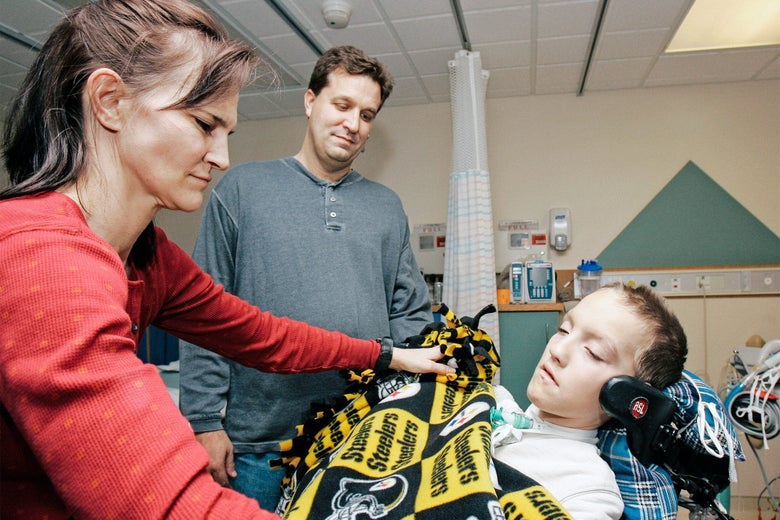
Although The Boy Who Came Back From Heaven has been off shelves for years now, yanked by the publisher after Alex'due south disavowal, the drama around it has quietly continued to roil. Last year, Alex filed a lawsuit against Tyndale House, a major Christian publisher based in suburban Chicago, accusing the company of defamation and exploitation, among other charges. He's seeking a payout at least equal to the book's profits. Alex, who recently turned 21, at present lives with his mother. He was valedictorian of his high school, just he has been a quadriplegic since the blow and requires full-time care. Kevin and Beth divorced last yr, and Beth says she has no idea what happened to the money Kevin earned from the book. The accommodate alleges that she and Alex are "on the verge of existence homeless." Alex was a small-scale when the book was published, and claims he was not a party to the contract. (Tyndale says in court filings that Kevin entered into an understanding on his ain and Alex's behalf, and that while Beth was non political party to the contract, she "consented every bit a matter of fact" to the book's production past helping to adapt interviews and supplying family unit photos.) A approximate has dismissed most of the lawsuit's counts. The side by side court date is in Baronial.
According to Alex and his mother, it was Kevin Malarkey who turned an injured male child's murmurings about angels into a complex story of a journey to sky and back. As Alex's lawsuit describes it, Kevin "concocted" the story that Alex had gone to heaven. Though Alex was billed as the book'due south co-writer, he told me he has never even read the full contents of The Boy Who Came Back From Heaven, let alone knowingly contributed to information technology. He said that some of the passages under his name were drawn from conversations with his begetter, simply he didn't realize they were intended for a book. "I didn't write it," Alex told me. "I have no thought what'due south in it. I don't know what I said." He knows plenty almost the book, even so, to feel sure that it doesn't represent what really happened.
No one spoke upwards to defend the book later on Alex recanted his version of events. Tyndale caved quickly, not only taking the volume out of print but also announcing it was "saddened to acquire" that Alex now claimed to have made up the story. In the years since, the book has come to seem to most people like a straightforward example of fakery and exploitation. Kevin Malarkey, who had been the book'southward chief promoter, stopped giving interviews the day of his son'southward disavowal. He has not spoken to the press in more than iv years. He disappeared so completely that the Washington Post reported last yr that he was dead. Until recently, on a weekend afternoon, he finally decided to tell his version of the events that rocked the Christian publishing industry and tore his own family unit apart.
Even when Alex was still in a coma, the family saw their story as cipher curt of miraculous, Kevin writes in the book. Their son had defied the odds past surviving at all, and soon his recovery was drawing people together and strengthening the religion of strangers. A family unit friend set upwardly a website, prayforalex.com, to coordinate volunteers for meals, kid intendance, and prayer. The site is now defunct, merely some of its pages tin still exist retrieved via the Wayback Automobile, and I was able to acquire an additional stack of printouts of various posts and comments; all of this now reads similar a fascinating, real-time first draft of Alex's story and the rapturous manner readers responded to it. Prayforalex.com became a community for people who were invested in Alex's recovery, including many who had never met him. Strangers and new friends posted prayers and stories about the ways they saw God moving in their own lives. "At that place is no incertitude in my mind that Alex and this family unit are anointed with the ability of Christ placed on them," wrote one commenter.
The family unit'south organized religion fed their optimism. Kevin writes in the book that after the car accident, he was consumed past guilt for months, but that Alex forgave him completely shortly after he was able to speak. When Alex had a bad breathing episode, Beth wrote on the site in January of 2005, she suspected "Satan knew that I was a little down and he tried to bother me more." Beth saw Satan's influence in her own burnout and discouragement; she and Kevin often put out calls for emergency prayers to foil his plans. "[Our family unit'due south spiritual battles are] very existent and I sure wish that it was merely a fictional business relationship," Beth wrote when she sensed Satan was trying to demoralize Alex in his recovery. The family's church building, Bellefontaine First Church of God, taught them that the Holy Spirit was actively working in the world, contesting demonic forces in real time. The family's pastor at the time, Gary Brown, told me that he and a friend once felt inspired to drive to the Malarkey family home and walk a circle around the business firm praying for the family's immediate spiritual protection from some kind of demonic force. "The state of war was very real," he said of that time in the Malarkeys' lives. "The spiritual warfare was very real."
Alex's recovery was slow, only he was able to communicate more as the months wore on. According to his parents' posts on the website, he began to share details with Kevin and Beth about his trip to sky at the blow scene, and his ongoing encounters with angels and demons. Kevin and Beth both posted on prayforalex.com nigh the stories Alex told them about his supernatural encounters. Beth put a note by Alex'due south hospital bed, informing visitors that when his mouth was open up wide, that meant angels were in the room. On Valentine'south Twenty-four hours, Beth posted a lengthy entry about what Alex had told her about sitting "in the lap of Jesus" at the accident scene: "Jesus told him he that he would breath but did non say when." Readers devoured the stories virtually Alex's visions. "I love to hear about our home in heaven," 1 frequent poster wrote. Another reader sent the family a painting of Alex in his hospital bed, surrounded by iii angels.
People around Alex were having their own supernatural experiences, too. A volunteer who stayed with Alex overnight at the hospital wrote that she heard the faucet in his room turn on and off iii times, even though no one else was present. "After that, I had the distinct feeling that I was in the presence of Angels," she wrote. The angels she envisioned were belongings Alex's cervix, and she could sense bones beingness realigned and nerve passages reopened. She recalled that one angel spoke to her, saying, "There is more to do, but this is all for now." Kevin wrote on the site that he felt God tell him at church ane twenty-four hours: "He will walk." The license plate on the family unit's xv-rider van, a souvenir from a local church building, read "WIL WALK."

He didn't. Alex came home from the infirmary in Feb 2005. Iv years afterwards, he underwent a process known as "the Christopher Reeve surgery" to allow him to exhale without a ventilator. He received some local news coverage at the time, because he was the youngest patient to have had the circuitous procedure. Afterward an Associated Press reporter mentioned offhand to Kevin that he should write a book, every bit Kevin explains in The Boy Who Came Dorsum From Heaven, Kevin met an agent and signed a contract with Tyndale. At the time, the volume was tentatively titled Angel Male child: The Boy Who Spent 7 Weeks in Heaven. The primary text is written in Kevin's voice, but the volume'south first nine chapters include separate sections written in Alex's phonation, with titles like "Angels Helping Me" and "I Nonetheless Visit Heaven." Several sidebars are attributed to Beth. Simply what happened afterwards Kevin signed that contract is at the eye of the conflict notwithstanding swirling around the volume: Who wrote what, and what did they really believe about what they were writing?
Book publishers don't ordinarily fact-check books. They'll run sensitive material by lawyers, only otherwise it's on authors to brand sure their work is authentic. By and large, this works out fine. Sometimes, information technology does not. When books similar James Frey's A One thousand thousand Little Pieces and the Holocaust chronicles Misha and Affections at the Fence were exposed equally being at least partly fabricated, it cost the publishers both expense and embarrassment. Memoirs, which oft rely on a single person's account of an extraordinary drama, are particularly vulnerable to this kind of spectacular collapse.
"Truth" in memoir is a knotty question to begin with, but at evangelical publishing houses, there'south an extra layer of complexity. For these publishers, the Bible itself is presumed to exist truthful, and their corporate mission is to advance that truth—and sell books in the process. Tyndale, which was founded as a Bible publisher in the 1960s, has self-professed "core values" that include "dependent on God," "trustworthy," and "anchored in the Bible."
"As Christians, we believe in miracles and believe in angels, but you have to make sure the source is credible," said Vander Zicht, who retired from Zondervan last year subsequently 33 years. Every bit an editor, she says, she vetted spiritual accounts by whether they came through a reputable literary agent, and past talking with authors to get a gut sense of their trustworthiness; occasionally she asked theologians to appraise books for biblical correctness. She said she wouldn't have rejected a heaven story out of hand. But Vander Zicht said she one time turned downward the opportunity to acquire a similar nonfiction account of a heaven story with a immature child at the eye. "I felt the volume shouldn't exist published until the boy was old enough to tell information technology himself," she said. "I suspected information technology would be a bestseller, but I was uneasy."
"You didn't have to be a theological whiz to immediately see problems with these books," said Justin Peters, a conservative independent evangelist who has been disquisitional of the heaven genre, and who is friendly with Beth and Alex. Peters previously sat on the lath of LifeWay, a publisher and (at the time) a major concatenation of Christian bookstores. He says he had tried unsuccessfully to convince LifeWay to stop selling heaven books and others he deemed theologically problematic.
No one I spoke with suggested that Tyndale might accept known Alex wasn't on board with writing a story that only he could've told. But in retrospect, there were signs of problem. A ghostwriter hired to polish the book told me he spoke with Kevin often and interviewed other sources, including doctors who had been involved with Alex's intendance. But he plant it odd that his requests to interview Beth were brushed off by Kevin. The ghostwriter never spoke with Alex either. In the end, his draft was rejected by Kevin through Tyndale. The draft that was published was written by Kevin himself. (The ghostwriter asked to remain bearding because he continues to piece of work in the Christian publishing industry.)
Tyndale likewise commissioned a brusque documentary to be sold equally a DVD accompaniment to the volume. Though Beth allowed the filmmakers into her home and sat for interviews with them in the spring of 2010, they told me that she and Alex proved elusive as subjects. Alex, they were surprised to detect, was unwilling or unable to repeat the stories well-nigh his encounters with angels and Jesus. "Nosotros expected him to give u.s.a. some version of what was in the volume," the film'southward co-editor and director of photography, Marking Schlicher, said. "That was obviously the money interview." The coiffure came back a second day to try to coax Alex into speaking more openly and still got almost nothing, although Kevin was in the room encouraging him to talk. "I nearly got the idea he was resistant to anybody putting words in his mouth—fifty-fifty at his immature historic period," said Ken Carpenter, the director. Schlicher and Carpenter both recollect some kind of disharmonize betwixt Kevin and Alex over Alex's unwillingness to open up up on camera.
Alex and Beth are conspicuously notwithstanding wary of having their story told. When I spoke to them on the phone, their lawyer sat in on the call; my requests to speak to Alex individually were denied. (They are represented by a house headed by prominent religious-liberty lawyer David Gibbs III, who represented Terri Schiavo's parents in their attempt to go on her on life back up against her married man's wishes.) Together, they described years of feeling manipulated and railroaded by Kevin, who they claimed put the volume before the family over and over, even though they had only a hazy thought of what he was working on.
Alex told me that in reality, he doesn't remember annihilation about the accident, and the whole thought that he saw angels started as a mix-up: He awoke alone in his dark infirmary room, and looked groggily into the bright hallway, where he saw his male parent talking to someone. "I thought it was an affections, because I idea I was expressionless," he told me. "I don't know why I thought that, but I did, and that's what I remember." He has said he told those supernatural stories as a kid because he idea it would get him attention. The whole thing "got blown out of proportion," he told me. Yes, his father would enquire him questions and write things downward, just he had no idea why. "I thought he was writing downward something to talk about at church or something," Alex said. "I didn't even know it was going to be a volume." Beth, meanwhile, now says she was opposed to the project from the start. About of the cursory sidebars in the book attributed to her were taken from her posts on prayforalex.com without her permission, she said: "I never approved of the volume, and I never cooperated with it." Beth recalls that she'd told Kevin at least one time in a tense medical moment, "You'd meliorate not put that in your volume," to no avail. She says that her theology back when she was writing posts on prayforalex.com "was not every bit audio equally it is now"—she was more open to assertive in near-death experiences—and she was "grasping at any signs of hope that I could find."
After the volume was published, and as the family relationship deteriorated, Beth and Alex turned to contacting outsiders. In August 2011, Alex left a annotate on a Facebook fan page for the book, calling information technology "1 of the most deceptive books ever." The comment was deleted, co-ordinate to a 2015 report in the Guardian. Beth started writing to Tyndale the next year to mutter about the book, though it's not clear she raised specific objections about the truth of Alex's supernatural encounters. Tyndale offered to meet with her, simply she declined, citing Alex's health. She left comments on Christian blogs, and she told a radio show that Alex was opposed to the volume. She also reached out to conservative writers who were publicly skeptical of the heaven genre on theological grounds. Several of them, and the pastor of Beth and Alex's electric current church, accept connections to the ministry building of John MacArthur, an influential conservative California pastor who is disquisitional of the charismatic theology behind phenomena like religion healing and out-of-body experiences. In 2012, Beth reached out to his ministry later on his website posted a slice titled "The Burpo-Malarkey Doctrine" that called firsthand accounts of heaven "but untrue."
None of these attempts to discredit the book stuck. In 2013, Beth wrote a 7,000-word post on her (now offline) personal web log; as an attempted exposé, the post, which I also read via the Wayback Machine, is confusing. Information technology does not mention Kevin or Tyndale by name, does non mention angels or Alex's heaven stories, and is bogged down by thousands of words of medical details. Beth's master objection seems to be that she did not want her words to exist included in the volume, that Alex'south wellness was depicted in the book as more stable than it actually was, and that the book is theologically incorrect. The postal service concludes: "I will do whatever I tin can to terminate the exploitation of my son and the twisting of God'southward truth." (In response to specific questions almost Alex's suit and the volume's origin, a representative from Tyndale offered a statement: "Tyndale has the deepest sympathy for this swain'due south circumstance, and we pray for him and his family regularly. We likewise note that Tyndale obtained proper consent to publish the book and paid everything that was owed under the contract. Since the litigation is still pending, Tyndale cannot comment further.")
Eventually, Alex himself emailed a rabble-rousing bourgeois web log, Pulpit and Pen, that had been sharply critical of the mainstream Christian publishing industry for bereft theological rigor. The blogger, J.D. Hall, a pastor in Montana, asked him if he would publish an open alphabetic character on the site. Hall said he called Alex on the phone every night over the form of weeks, writing and revising a statement in which Alex disavowed the book completely. Hall posted information technology on Jan. xiii, 2015. Finally, it was over: Tyndale pulled the book from circulation, and after a frenzy of rubbernecking publicity, the globe moved on. A few months later, LifeWay announced it had stopped selling all "experiential testimonies about heaven," dramatically reducing the market for future stories like Alex's.
I emailed Kevin Malarkey near the end of my reporting. I had heard he was quick to anger, and I knew he hadn't spoken to whatsoever reporters since the volume's collapse. One source called him a "mean guy," and said Kevin had warned him to stay off his belongings. Beth described him as intimidating, and said he had abandoned her with no warning concluding yr and had rarely spoken to her and Alex since. I didn't think Kevin would talk to me at all.
Kevin wrote me dorsum on a Sat forenoon. He was at his son's baseball game, he said, merely if I wanted, I could call him back and try to explain what I was working on. By the fourth dimension I did, the game was over, and his youngest son was in the car; Kevin asked him to put on headphones so he wouldn't hear our conversation. When we kickoff started talking, Kevin said he would only speak to me off the record. Only a few minutes into our call, he changed his heed. He said he had prayed most whether or not to speak to me, and received an answer: "Talk to her." We spoke that afternoon for almost two hours.
Kevin Malarkey didn't disappear from the public middle considering his lies had been exposed, he told me. He disappeared because God told him to be silent, because anything he would say publicly would farther hurt his family. "All it would do was brand Alex await worse, make Beth look worse," he said. "Alex either lied when he was 6 or when he was 18." Kevin said that Alex spoke openly and frequently about his encounters with angels and demons for years, and that they worked closely together on his portions of the volume. (Beth said that "a little male child who had only come out of a major coma" couldn't be expected to understand that he was collaborating on a book.) Couldn't Alex take just been trying to please his father with those stories, I wondered? He was too young to simulated it and then assuredly, Kevin insisted. "I notwithstanding believe it today," he said. "I absolutely believe everything in that book."
The Boy Who Came Back From Heaven insists that it is an inspirational volume, but reading information technology now is heartbreaking. The family'due south financial stress is a abiding theme. As early on equally Page 2, Kevin writes that the family'southward new insurance plan didn't encompass the new baby's infirmary birth; two pages later, he mentions a missed mortgage payment. He reminds himself: God volition come across our needs. Meanwhile, he returns over and over to the problems in his marriage, writing about his and Beth's acrimony, irritability, and distance. "Our human relationship suffered cracking trauma," he writes, "not only during Alex's first weeks in the hospital, but also for years afterward the blow."
Kevin and Beth kickoff met when she moved in next door to him, Kevin said, and Kevin "led her to Christ" and baptized her. Kevin told me the human relationship was contentious almost from the start. (Beth described it as "dysfunctional.") Alex was born three years into their marriage, and by the time of the accident the Malarkeys were a family of six. The friction in the matrimony was obvious to their children. In a 2005 mail on prayforalex.com that Kevin said he posted on Alex's behalf, the boy wrote to his thousands of followers: "Please pray for mommy and daddy to make it less figts." Kevin slept in a guesthouse on their belongings for the last few years of their union. By that time, he said, Beth did not speak to him or acknowledge him when he entered the room. In Kevin'southward recollection of that contentious DVD filming at the business firm, the conflict was not between Alex and himself, only between himself and Beth: "[Alex] probably felt in the middle of his parents, unfortunately."
Kevin and his oldest son had been close earlier the accident, and it is clear from the posts on prayforalex.com that Kevin spent significant fourth dimension with Alex at the hospital. Afterward Alex came home, in Kevin'south account, Beth took over Alex's care and Kevin took charge of the three younger children, while he continued to work full time. He said Beth essentially cutting him off from Alex, always finding an excuse to be in the room or to whisk him off to minister to him. Kevin and a family friend he put me in bear on with, Jami Mosgrove, both said they suspected Beth would utilise Alex's demand to take his legs manually exercised equally an excuse to shoo others out of the room. (Beth told me that Kevin "never engaged" in Alex'due south care. Kevin, meanwhile, said he was intensely involved in Alex'south medical care in the early years later on the accident, but that Beth eventually stopped updating him nearly Alex'southward care.) By the time Alex disavowed the book in 2015, his human relationship with his begetter had deteriorated, which Kevin attributes to Beth's influence. But Kevin remains injure by the fact that his son didn't come to him first. "Alex never told me he fabricated the volume up," he said. "I found out when it was in the national news."
One reason Kevin says he still believes in the book is because he is accustomed to having intense spiritual experiences himself. In one case, Kevin wrote in the book, Alex told him he would encounter an affections named John; that evening, while taking out the trash, Kevin felt an unseen presence "[speaking] to me in my spirit," offering specific words of encouragement that he raced inside to write down. These days, he prays early on every morning and takes notes in a journal about what he perceives he is hearing from God. He acknowledges it can exist hard to sort out God's intentions from his own, but he figures if the bulletin is uncomfortable or hard—like a command to forgive someone, or to act confronting his own interests—then it's likelier to come up from God. Sometimes the directions are specific. At a speaking engagement at a church earlier the book fell apart, he says he received an teaching to set aside his notes and simply pray. In his own church building recently, God told him to give a message to a adult female he didn't know well. He's comfortable with the fact that this may sound strange. "The other day, when I was praying, I felt like he was saying to me, 'I take no interest in yous understanding your own life. I have an interest in you post-obit me,' " he said. "I was like, 'That sounds like something y'all would say.' "
Kevin says he'd hoped the volume would exist about the "church building being the church": a positive story well-nigh Christians rallying around a family in crisis. Simply he knows that it was Alex's heaven stories that secured him the contract with Tyndale. "Information technology's an absolutely wonderful story that should be told," he recalls his agent, Matt Jacobson, proverb. "Because there was a heaven experience, it will be told." (Jacobson declined an interview asking.)
Those close to Kevin limited frustration that he stayed silent so long about a volume whose story he nonetheless believes. "[Nosotros've] been urging him to say something," said Paige Gutheil Henderson, a family unit doctor who runs the medical group that hosts Kevin's current counseling practice. Kevin estimates that he earned nigh $i 1000000 from the book, including a $500,000 accelerate. The money is gone now, he says. He was the family's sole breadwinner, and Alex's medical expenses were high. Yes, he signed the contract on his ain and Alex's behalf, simply there were no provisions for Alex to exist paid separately, he said; Alex was a minor, and the book proceeds went to his food, medical care, and other family expenses. But Kevin besides says that when he received the accelerate, he fabricated extravagant—what some might call impulsive—gifts to Christian charities and individuals in his church. At ane point, he claims, he wrote a check for $30,000 to his church. (The church did not respond to requests for comment.) He lost more than that when he invested in a friend'due south failed startup. When he and Beth divorced, she and Alex kept living in the house, and he moved into a small rented house, he says, furnished through garage sales and curbside discards.
I reached out to Beth and Alex to ask if we could speak again, to give them a chance to respond to the specifics of Kevin'southward account. I besides asked if I could speak to Alex lonely. They denied my request through their attorney, who said Alex did not want to "stir up additional difficulty with his father." When I then sent a detailed listing of statements and questions to the attorney to again give Beth and Alex the hazard to respond, he told me that Alex was in the hospital. "Alex and Beth are busy dealing with the consequences of the physical harm Kevin did to Alex," the attorney later wrote. "For that reason, they are not currently in a position, personally, to address the harm that Kevin did through the publication of the book and the mishandling of the money Kevin made from the book." But more than a week later, Beth sent an electronic mail with brief responses to some statements through her attorney, disputing, for example, his exclamation that she cut him off from Alex'due south care: "False," she wrote. "He removed himself."
Aaron Malarkey, one of Alex's brothers, is 18 years old now; he was 8 when the volume was beingness written. He says he felt betrayed when his brother recanted the story. "There's been a lot of false testimony and lies—flat-out lies—in the public middle about my dad," Aaron said. He describes his older brother as a quick thinker, charismatic, and "one of the funniest people you'll encounter." But it makes him sad that in large role thank you to Alex, his male parent is at present viewed by so many every bit a adventurer.
Aaron and his two younger siblings chose to alive with Kevin after their parents' divorce. He struggles with bitterness over the manner his begetter was "thrown to the wolves," and abased by fellow Christians who had then eagerly consumed his family unit's story. He sees his mother and blood brother in one case a week and emphasized that he loves them securely.
Aaron says he was in the room while Kevin and Alex worked on the volume. "I remember very clearly, my dad would enquire Alex, 'Are you absolutely sure you lot want me to put this in the volume?' There were times he'd say yep and times he'd say no, and my dad would follow." It was obvious his mother was unhappy with the projection, he said. But at the fourth dimension, what made a bigger impression on Aaron was his blood brother's apparent communication with the spirit realm; in the middle of conversations, he would terminate and announce there were angels in the room. Of grade, our memories of what happened when we were viii years old are hazy, and young children are hardly impartial observers of complicated parental dynamics. But Aaron believed his brother's story completely, and yet does. "Even when my faith has been iffy," he said, "I never doubted it was true."
It was always easy, perchance as well like shooting fish in a barrel, for secular skeptics to mock The Male child Who Came Back From Heaven. But criticism from bourgeois Christians was more searing, because it implied the book had done existent impairment. "The idea that someone could go to sky and come back with visions and dreams and nosotros should take that seriously is as far from historic evangelicalism equally information technology's possible to become," Phil Johnson, the executive director of the ministry headed by MacArthur, the California pastor and author whose ministry building Beth reached out to in 2012. "To me, i of the real signifiers that modern evangelical Christianity is badly off-target and in serious jeopardy of even existing 50 years from now is the ease with which evangelicals buy into stories like this." To Christians of Johnson's theological bent, it'southward a problem that books like the Malarkeys' claim to be new, specific revelations from God, and they contradict the Bible in obvious ways. (The Bible says God the Father cannot be seen past humans; Alex describes his trunk.) Other issues should be obvious to anyone: The various books' descriptions of sky are inconsistent with each other.
The Malarkeys' stories are inconsistent, likewise. Kevin and Beth are so combative now that they can't even agree on how exactly their antagonism adult. In the middle of it all is Alex, the male child—now a man—whose story about a trip to heaven disintegrated into a very specific kind of family hell: a serial of lawsuits, an ugly divorce, physical suffering, anger, loneliness, imperfect memories, mistakes, money struggles, lingering resentments and heartbreak in all directions. This is painful, decidedly earthly stuff.
Nevertheless Alex's story—the one he says never happened—gave thousands of people hope. It promised that God is real, that nosotros volition see our lost ones again, and that later we will alive forever in peace, somehow. His disavowal of that business relationship may have squashed the marketplace for those detail kinds of stories, but it'south hardly surprising that there are however plenty of successful books with a distinct echo of the same genre. At that place was the 2017 memoir The Impossible, which tells the story of a mother'southward desperate prayer for her son's "resurrection" after an accident; the moving-picture show version of this "miraculous truthful story" took in more $40 million in theaters this bound. Jesus Calling, a xv-year-one-time devotional written in the voice of Jesus by a woman who said she received "personal messages from God," is one of the well-nigh successful Christian books of the millennium and remains a bestseller. There volition always be an ambition for stories that are not just too adept to check, but literally impossible to verify. The whole indicate of organized religion, afterward all, is that it requires believing in what 1 cannot entirely see—simply what others may have been blessed enough, on occasion, to witness.
Prayforalex.com, the site where Alex's supporters gathered to receive updates and share stories, has been offline for years. Still, those posts at present read similar a powerful exhibition of why and then many millions of readers are so eager to purchase books most living people who claim they have seen heaven with their ain eyes. "This gives me then much personal force," an early reader wrote, in response to a post from Beth about coming together someone else who had a visit to sky similar to Alex's. "My dad built the nigh cute things out of forest, I just wonder if he has a hand edifice our mansions [in sky]. I at present wonder about the music and everything he is experiencing. When Alex tells what he saw, it brings such peace to this sorry time." Another reader added that she got goosebumps reading Beth'due south mail. "Home," she wrote. "It will exist then prissy to one day be there."
mcveysearturefor96.blogspot.com
Source: https://slate.com/human-interest/2019/07/the-boy-who-came-back-from-heaven-christian-book-scandal.html
0 Response to "Why Does Kevin Lyttle Does Not Make Sons Again"
Postar um comentário