What Is Required to Separate Actin and Myosin During Sarcomere Contraction?
| Sarcomere | |
|---|---|
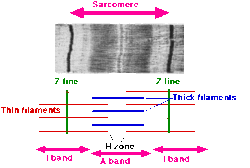 Image of sarcomere | |
| Details | |
| Function of | Striated muscle |
| Identifiers | |
| Latin | sarcomerum |
| MeSH | D012518 |
| TH | H2.00.05.0.00008 |
| FMA | 67895 |
| Anatomical terms of microanatomy [edit on Wikidata] | |
A sarcomere (Greek σάρξ sarx "mankind", μέρος meros "part") is the smallest functional unit of striated muscle tissue.[one] Information technology is the repeating unit between ii Z-lines. Skeletal muscles are equanimous of tubular muscle cells (called muscle fibers or myofibers) which are formed during embryonic myogenesis. Muscle fibers contain numerous tubular myofibrils. Myofibrils are composed of repeating sections of sarcomeres, which announced nether the microscope as alternating night and light bands. Sarcomeres are composed of long, fibrous proteins every bit filaments that slide past each other when a musculus contracts or relaxes. The costamere is a different component that connects the sarcomere to the sarcolemma.
Two of the of import proteins are myosin, which forms the thick filament, and actin, which forms the thin filament. Myosin has a long, fibrous tail and a globular head, which binds to actin. The myosin head also binds to ATP, which is the source of energy for muscle movement. Myosin tin only bind to actin when the binding sites on actin are exposed past calcium ions.
Actin molecules are jump to the Z-line, which forms the borders of the sarcomere. Other bands appear when the sarcomere is relaxed.[ii]
The myofibrils of polish musculus cells are not arranged into sarcomeres.
Bands [edit]

The sarcomeres give skeletal and cardiac muscle their striated appearance,[2] which was first described by Van Leeuwenhoek.[3]
- A sarcomere is defined as the segment between two neighbouring Z-lines (or Z-discs). In electron micrographs of cross-striated muscle, the Z-line (from the German "zwischen" meaning between) appears in betwixt the I-bands equally a dark line that anchors the actin myofilaments.
- Surrounding the Z-line is the region of the I-ring (for isotropic). I-band is the zone of thin filaments that is non superimposed by thick filaments (myosin).
- Following the I-ring is the A-band (for anisotropic). Named for their backdrop under a polarized light microscope. An A-band contains the entire length of a unmarried thick filament. The anisotropic band contains both thick and thin filaments.
- Within the A-band is a paler region called the H-zone (from the German "heller", brighter). Named for their lighter advent nether a polarization microscope. H-band is the zone of the thick filaments that has no actin.
- Within the H-zone is a thin K-line (from the German "mittel" meaning eye), appears in the middle of the sarcomere formed of cross-connecting elements of the cytoskeleton.
The relationship betwixt the proteins and the regions of the sarcomere are as follows:
- Actin filaments, the sparse filaments, are the major component of the I-band and extend into the A-ring.
- Myosin filaments, the thick filaments, are bipolar and extend throughout the A-band. They are cross-linked at the centre by the Thou-band.
- The giant poly peptide titin (connectin) extends from the Z-line of the sarcomere, where it binds to the thick filament (myosin) system, to the M-ring, where information technology is idea to interact with the thick filaments. Titin (and its splice isoforms) is the biggest single highly elasticated protein found in nature. Information technology provides binding sites for numerous proteins and is idea to play an important role as sarcomeric ruler and as blueprint for the associates of the sarcomere.
- Some other giant protein, nebulin, is hypothesised to extend along the thin filaments and the entire I-Band. Similar to titin, it is thought to deed as a molecular ruler along for thin filament associates.
- Several proteins of import for the stability of the sarcomeric structure are establish in the Z-line also equally in the M-ring of the sarcomere.
- Actin filaments and titin molecules are cross-linked in the Z-disc via the Z-line poly peptide alpha-actinin.
- The Chiliad-ring proteins myomesin as well every bit C-protein crosslink the thick filament organization (myosins) and the Thousand-ring part of titin (the rubberband filaments).
- The M-line also binds creatine kinase, which facilitates the reaction of ADP and phosphocreatine into ATP and creatine.
- The interaction between actin and myosin filaments in the A-band of the sarcomere is responsible for the muscle contraction (based on the sliding filament model).[two]
Contraction [edit]
The protein tropomyosin covers the myosin-bounden sites of the actin molecules in the muscle cell. For a muscle cell to contract, tropomyosin must be moved to uncover the bounden sites on the actin. Calcium ions demark with troponin C molecules (which are dispersed throughout the tropomyosin protein) and alter the structure of the tropomyosin, forcing information technology to reveal the cross-bridge bounden site on the actin.
The concentration of calcium within muscle cells is controlled by the sarcoplasmic reticulum, a unique form of endoplasmic reticulum in the sarcoplasm.
Muscle cells are stimulated when a motor neuron releases the neurotransmitter acetylcholine, which travels across the neuromuscular junction (the synapse between the terminal bouton of the neuron and the muscle jail cell). Acetylcholine binds to a post-synaptic nicotinic acetylcholine receptor. A change in the receptor conformation allows an influx of sodium ions and initiation of a post-synaptic action potential. The action potential then travels along T-tubules (transverse tubules) until it reaches the sarcoplasmic reticulum. Here, the depolarized membrane activates voltage-gated L-blazon calcium channels, nowadays in the plasma membrane. The L-type calcium channels are in close association with ryanodine receptors present on the sarcoplasmic reticulum. The inward menstruation of calcium from the L-type calcium channels activates ryanodine receptors to release calcium ions from the sarcoplasmic reticulum. This mechanism is called calcium-induced calcium release (CICR). It is not understood whether the concrete opening of the Fifty-type calcium channels or the presence of calcium causes the ryanodine receptors to open. The outflow of calcium allows the myosin heads access to the actin cantankerous-bridge binding sites, permitting musculus contraction.[four]
Muscle wrinkle ends when calcium ions are pumped dorsum into the sarcoplasmic reticulum, assuasive the contractile appliance and, thus, muscle prison cell to relax.
Upon musculus contraction, the A-bands practice not change their length (one.85 micrometer in mammalian skeletal musculus),[4] whereas the I-bands and the H-zone shorten. This causes the Z lines to come closer together.
Rest [edit]
At rest, the myosin caput is bound to an ATP molecule in a low-energy configuration and is unable to access the cross-bridge bounden sites on the actin. However, the myosin head can hydrolyze ATP into adenosine diphosphate (ADP and an inorganic phosphate ion. A portion of the energy released in this reaction changes the shape of the myosin head and promotes it to a high-energy configuration. Through the process of bounden to the actin, the myosin head releases ADP and an inorganic phosphate ion, changing its configuration back to one of low energy. The myosin remains attached to actin in a state known as rigor, until a new ATP binds the myosin head. This binding of ATP to myosin releases the actin by cantankerous-bridge dissociation. The ATP-associated myosin is ready for some other cycle, outset with hydrolysis of the ATP.
The A-ring is visible as dark transverse lines across myofibers; the I-band is visible as lightly staining transverse lines, and the Z-line is visible as dark lines separating sarcomeres at the light-microscope level.
Storage [edit]
Most muscle cells can only store enough ATP for a small number of muscle contractions. While muscle cells also shop glycogen, well-nigh of the energy required for contraction is derived from phosphagens. Ane such phosphagen, creatine phosphate, is used to provide ADP with a phosphate group for ATP synthesis in vertebrates.[four]
Comparative structure [edit]
The structure of the sarcomere affects its function in several ways. The overlap of actin and myosin gives rising to the length-tension curve, which shows how sarcomere force output decreases if the musculus is stretched so that fewer cross-bridges can form or compressed until actin filaments interfere with each other. Length of the actin and myosin filaments (taken together as sarcomere length) affects forcefulness and velocity – longer sarcomeres have more cross-bridges and thus more force, but have a reduced range of shortening. Vertebrates display a very limited range of sarcomere lengths, with roughly the aforementioned optimal length (length at peak length-tension) in all muscles of an individual as well equally betwixt species. Arthropods, however, show tremendous variation (over vii-fold) in sarcomere length, both between species and betwixt muscles in a single individual. The reasons for the lack of substantial sarcomere variability in vertebrates is not fully known.[ citation needed ]
References [edit]
- ^ Biga, Lindsay Yard.; Dawson, Sierra; Harwell, Amy (2019). "10.2 Skeletal Muscle". Beefcake & Physiology. OpenStax/Oregon State University. Retrieved 22 May 2021.
- ^ a b c Reece, Jane; Campbell, Neil (2002). Biological science . San Francisco: Benjamin Cummings. ISBN0-8053-6624-v.
- ^ Martonosi, A. N. (2000-01-01). "Brute electricity, Ca2+ and musculus contraction. A brief history of muscle research". Acta Biochimica Polonica. 47 (iii): 493–516. doi:10.18388/abp.2000_3974. ISSN 0001-527X. PMID 11310955.
- ^ a b c Lieber (2002). Skeletal Muscle Structure, Function & Plasticity : The Physiological Basis of Rehabilitation (2nd ed.). Lippincott Williams & Wilkins. ISBN978-0781730617.
External links [edit]
 | Wikimedia Commons has media related to Sarcomeres. |
- MBInfo: Sarcomere
- MBInfo: Contractile Fiber
- Muscular Tissues Videos
- Histology prototype: 21601ooa – Histology Learning System at Boston University - "Ultrastructure of the Cell: sarcoplasm of skeletal muscle"
- MedicalMnemonics.com: l 379 107
- Images created by antibody to striations
- Muscle Contraction for dummies
- Model representation of the sarcomere
mcveysearturefor96.blogspot.com
Source: https://en.wikipedia.org/wiki/Sarcomere
0 Response to "What Is Required to Separate Actin and Myosin During Sarcomere Contraction?"
Postar um comentário